



- Artificial Intelligence can be genius at making decisions automation, but when it presents itself as a "black box" and never explains how or why a decision was made, it is a compliance nightmare. Particularly important for Data Protection Officers (DPOs) under India's Digital Personal Data Protection (DPDP) Act, which requires transparency and accountability in automated data processing.
- In this blog, we discuss how DPOs can address the "black box problem" using Explainable AI (XAI), become compliant with DPDP's transparency standards, and work with developers to ensure AI accountability. Look for useful tools, industry insights, and a governance check list specifically designed for India's DPOs.
1. What is Explainable AI (XAI) and Why It Matters for DPOs
Explainable AI (XAI) is AI whose choices are comprehensible, understandable, and traceable by people, especially non-technical stakeholders such as regulators, DPOs, and users.
Why DPOs need to care:
- Transparency is not an elective under DPDP—it's essential.
- You can't audit what you can't explain.
- Explainability establishes user trust and facilitates effective consent.
Key XAI Concepts:
- Model Interpretability: Capability to demystify how a model makes decisions.
- Human Understand-ability: The explanation must make sense to laypersons, not just data scientists.
- Traceability: Being able to document what data led to which outcomes.
Food for Thought: A 2024 survey by PwC found that 76% of Indian enterprises using AI could not fully explain their algorithms—a glaring gap for DPOs.
2. Transparency by Design: What DPDP Demands from AI Systems
India's DPDP Act not only promotes transparency—it mandates it, particularly when AI decision-making affects people's rights.
DPDP Requirements for Transparency:
- Right to Information: Users need to be aware when decisions are AI-based.
- Purpose Limitation: Describe the purpose of data within specified aims.
- Notice Requirements: Express the logic and impact of AI decision-making clearly.
- Grievance Redressal: Make sure that people can appeal against AI decisions.
Responsibilities of DPO:
- Make sure AI vendors or in-house teams adhere to transparency obligations.
- Audit and record AI pipelines for explainability deficits.
- Write clean, end-user-visible notices on automated decisions.
Expert Insight: "Transparency is not only a principle under DPDP—it's an operational problem that should be addressed at design time."
3. Tools DPOs Can Use to Produce AI Explanations
Explainability is no longer a game of guesswork—there are mature tools that can be embedded in your AI pipeline.
Popular Tools and Frameworks:
- LIME (Local Interpretable Model-agnostic Explanations): Provides case-by-case justification for predictions.
- SHAP (SHapley Additive exPlanations): Dismantles feature importance for model predictions.
- AI Fairness 360 by IBM: Provides fairness and explainability metrics.
- Google's What-If Tool: Enables DPOs to visualize model behavior.
Tips for DPOs:
- Collaborate early with AI teams to have these tools integrated from Day 1.
- Develop SOPs that incorporate explanation-generation into compliance reports.
- Employ explanation outputs to enhance privacy notices and internal documentation.
4. What is "Sufficient Explanation" in Indian Law?
DPDP doesn't include a definition of "explainable," but we can take a guess of what would constitute sufficient based on international best practices and India's methodology.
Criteria for Sufficient Explanation:
- Plain Language: Refrain from using technical terms when speaking with data principles.
- Outcome Relevance: Explain the rationale for the final decision, not merely the input.
- Risk Clarity: Declare the possible impact of AI choices on individuals.
- Recourse Availability: Describe how the user is able to appeal or correct results.
DPO Tip:When unsure, try explaining your AI explanation to a non-tech co-worker. If they don't get it, your explanation isn't DPDP-ready.
5. DPOs vs. Developers: Who Does What in XAI Compliance?
Constructing explainability is collaborative. Yet who's responsible for what? Here's how to allocate responsibilities.
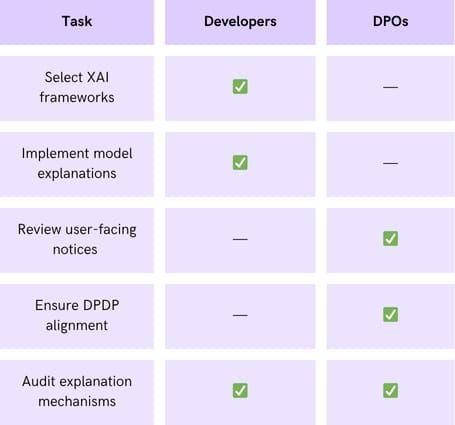
Collaboration Best Practices:
- Schedule periodic privacy-engineering syncs between developers and DPOs.
- Add explainability checks to Data Protection Impact Assessments (DPIAs).
- Monitor updates after each model iteration.
6. Sectoral Use Cases: XAI in Finance, EdTech, and Healthcare
Let's bring it to life. Here's how explainability works in various sectors—each with its own stake.
(a) Finance (Credit Scoring)
Risk: Biased loan denial
XAI Role: Explain what financial features affected scores.
DPO Goal: Maintain fairness and supply transparent reason codes to applicants.
(b) EdTech (Adaptive Testing)
Risk: Misinterpretation of student scores
XAI Role: Explain how question patterns are adjusted by student.
DPO Goal: Avoid algorithmic bias and provide teachers with comprehensible insights.
(c) Healthcare (Diagnosis Tools)
Risk: Wrong predictions with life-altering consequences
XAI Role: Illustrate which symptoms contributed to which risk category.
DPO Goal: Confirm clinical fairness and facilitate second-opinion routes.
7. XAI Governance Checklist for DPOs
Before approving AI-based processing, utilize this brief governance checklist:
- Have you recorded the aim and impact of automated decisions?
- Are XAI tools integrated into your AI lifecycle?
- Can your privacy notice present AI logic in plain language?
- Do users have recourse to challenge or appeal AI decisions?
- Have all explanations been validated by non-technical users?
- Are developer and DPO roles well-defined within AI governance policy?
8. Final Thoughts: Demystifying the Black Box Is a Compliance Imperative
- Explainability isn't technical—it's legal and ethical. DPOs need to claim it.
- DPDP places the responsibility for transparency squarely in the laps of organizations. XAI is your bridge.
- Begin small—integrate explainability tools into high-risk use cases.
- Cross-functional collaboration among DPOs, developers, and legal is essential.
As India tilts toward AI-driven systems, the DPO's role shifts from monitoring into proactive privacy engineering and AI governance. Don't be afraid of the black box—open it up, one explanation at a time.